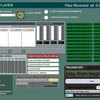


Auditory Fiction (2010), commissioned by the Ensemble Zellig and Société Générale, is cinema for the ears. The piece is an imaginary narrative that involves the use of a new tool for shaping musical time, Timewarp, designed by John MacCallum. In Auditory Fiction, the musicians play their parts by following in-ear click tracks which coordinate four independent, flexible, shifting sequences of time. Each instrument can act independently in time or join together in perfect synchrony. Closely layering temporal events can trick the auditory system and cause things to be heard that are not actually present...
Joshua Kosman reviewed Auditory Fiction in the San Francisco Chronicle after Ensemble Zellig’s Cal Performances concert on November 7, 2011. He described the work as an ingenious piece involving all four instrumentalists and newly developed computer software, noting that the players “float in and out of sync with each other” while the music maintains clarity, beauty, and subtle metrical variation.
Decades ago, Steve Reich pioneered phase shifting in live performance, but only with newer technology does full compositional control of smoothly varying tempos become possible. This technique presents a major challenge for both composer and performers: composing and performing in a musical space that is always in temporal flux. The tempo-editing tools were developed at the Center for New Music and Audio Technologies first by Matthew Wright and then by John MacCallum with Jeff Lubow. The current tool was largely architected by MacCallum, who calls the object “time-warp.”
Working with dynamic tempo maps forces a disconnect from many traditional compositional approaches, because those approaches do not always map meaningfully onto the new musical design space. In Auditory Fiction, the fixed instrumentation of flute, clarinet, cello, and piano was also a concern because it was not ideally matched to the primary software tool being developed. I am grateful to Ensemble Zellig for working with me on this project, and to Wright, MacCallum, and Lubow for their work in creating a composable tempo-curving tool.
Part of this project involved establishing a working environment that aligned the production process, tool-building, testing, performer feedback, and composition itself. Existing models of asynchronous, polytemporal, dynamic temporal music that informed this work include public bells, Balinese and Javanese performance practices, and earlier Campion pieces involving synchronized polytempos.